Taking notes has long been a cornerstone of learning and retention, yet the way we take notes can make all the difference between quickly forgetting something and remembering it for years. Whether you’re a student studying for finals or a professional keeping track of meetings, adopting more effective note-taking strategies can drastically improve how much you retain and how easily you can recall it later.
But what makes some note-taking methods more effective than others? The ZEBRA team dives into the science behind memory retention and explores innovative techniques that make your notes more, and also make them more memorable.
The Science Behind Effective Note-Taking
Note-taking is a cognitive process that—when done correctly—activates various regions of the brain, improving memory retention, understanding, and recall. Here’s how it works:
Active engagement enhances retention
Simply reading a textbook or listening to a lecture isn’t enough. To retain information effectively, your brain needs to be actively involved. This means summarizing ideas, organizing thoughts, and even teaching the material to someone else. These activities strengthen neural connections, helping the brain store information more deeply. Active engagement transforms passive input into meaningful knowledge. It encourages critical thinking, making it easier to apply what you’ve learned in different contexts.
Encoding and retrieval shape memory and retention
Every time you write something down, your brain encodes it—a process that determines how it will be stored. Structured notes, like outlines or categorized sections, make encoding more efficient by creating logical links between pieces of information. These same structures then serve as retrieval cues, helping your brain locate and bring back the information later. Strong encoding at the time of note-taking means less time spent re-learning later. Retrieval practice, such as quizzing yourself with your notes, reinforces these memory traces even more, and helps retention.
Different methods activate different brain areas for retention
Your brain is like a toolbox—each region is specialized for different tasks. Visual methods like mind mapping activate spatial and visual centers, auditory techniques reinforce memory through repetition and listening, and writing by hand engages motor areas, creating muscle memory. Using multiple methods increases your chances of retaining information by engaging more parts of your brain. This variety of engagement not only supports retention but also enhances flexibility in how you understand and recall concepts. It allows your brain to build richer, more durable memory networks.
Multisensory learning boosts recall
The more senses you involve in the learning process, the better. When you combine text, visuals, and verbal explanations, your brain forms stronger memory pathways. This multisensory approach means that when you need to recall something, you have multiple avenues to access it—whether it’s remembering a diagram, a keyword you wrote in red ink, or the way you explained it out loud. Each sensory input adds a unique layer to the memory, increasing the chance that one of them will trigger recall when needed. It also makes studying more engaging and less monotonous, helping motivation and focus.

Innovative Note-Taking Methods for Better Retention
To get the most out of your notes, try incorporating creative methods that go beyond the traditional outline or bullet point list to help retention. Here are some of the most effective and innovative techniques:
The Mind Mapping Technique
Mind maps are a visual representation of ideas, showing the relationships between concepts. Instead of writing information in a linear, top-to-bottom format, you begin with a central theme and branch out into subtopics and related ideas.
This layout mirrors how the brain naturally organizes information—non-linearly and through associations. That’s why it’s so effective at improving comprehension and recall. When you create a mind map, you’re not just recording facts; you’re building a structure of understanding.
Mind mapping is also a powerful tool for creativity and problem-solving. Seeing your thoughts spread out visually can help you recognize patterns, connect dots between unrelated topics, and generate new ideas. It’s an ideal method for subjects that require deep thinking—like business strategy, creative writing, or brainstorming sessions.
Sketchnoting
Sketchnoting is where doodles meet data. Instead of writing full sentences, this technique encourages you to use a mix of sketches, arrows, symbols, typography, and diagrams to summarize content. Think of it as visual storytelling for note-taking.
Why does it work? Research suggests that drawing information enhances memory because it combines motor skills, visual processing, and conceptual thinking. This taps into the dual coding theory, which states that the brain processes verbal and visual information in different areas—but when used together, they reinforce one another.
Even simple elements—like icons for key ideas, stick figures to represent characters or people, or arrows to indicate cause and effect—can help you break down complex topics and make them more memorable. Sketchnoting is particularly useful for lectures, podcasts, or visual learners who want their notes to be both functional and fun.
Color-Coding & Highlighting for Better Recall
There’s a reason highlighters are a staple in every study kit—color-coding helps memory stick and retention. But there’s more to it than just making your notes pretty. Using specific colors to mark different types of information can help the brain categorize and retrieve details faster.
For instance, you might use:
- Red for key terms
- Blue for definitions
- Green for examples
This creates visual cues that guide your eyes during review and reinforce understanding. The brain associates colors with meaning, so when you see blue in your notes, you’ll know to look for explanations. You can also use study tips to further improve retention.
However, there’s a trick to using color effectively—don’t overdo it. Highlighting full paragraphs can cause cognitive overload and defeat the purpose, hindering retention. Instead, focus on essential keywords and phrases. This forces your brain to engage in active reading, helping you focus on the most critical parts of the material.
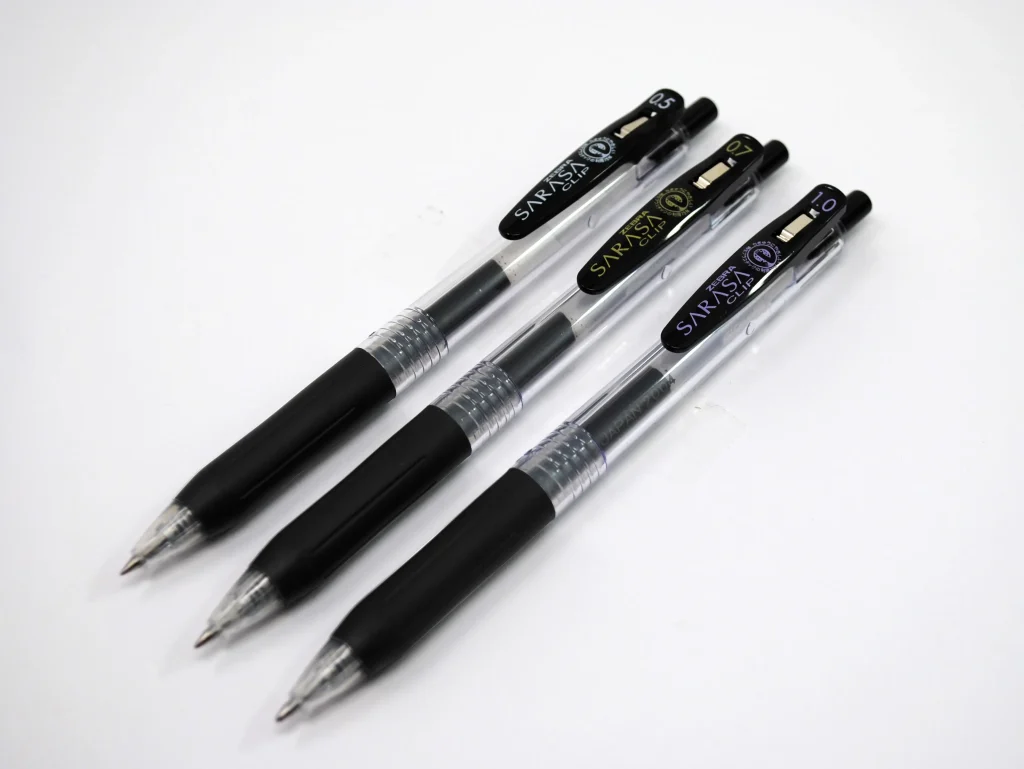
The Best Writing Instrument for Note-Taking: ZEBRA Sarasa Clip, and Sarasa Clip BioTube
No matter how effective your technique is, the right tools make a difference—especially when it comes to writing instruments. The ZEBRA Sarasa Clip and Sarasa Clip BioTube stand out as exceptional choices for those who want to create clean, colorful, and long-lasting notes.
ZEBRA Sarasa Clip
One of the biggest frustrations when reviewing old notes is trying to read smudged or messy handwriting, which is not benefitting retention. The Sarasa Clip’s smooth gel ink solves that problem with crisp, non-smearing lines that make your notes easy to read, even months later.
With over 40 ink colors and special collections like Vintage, Decoshine, and Milk, it’s perfect for color-coding. Whether you’re underlining headings, writing definitions in blue, or drawing arrows in orange, the Sarasa Clip gives you the creative freedom to personalize your notes—and the cognitive benefit of color association.
It also comes in multiple point sizes (0.4 / 0.5 / 0.7 / 1.0 mm), allowing you to adapt your style. Use finer points for detailed annotations or broader ones for bold headlines.
What makes it even better is the archival-quality, acid-free, and waterproof ink. That means your notes won’t fade or smear over time. This durability makes the Sarasa Clip a trusted companion, whether you’re preparing for exams, writing journal entries, or taking minutes during important meetings.
ZEBRA Sarasa Clip BioTube
If you’re someone who values sustainability, the Sarasa Clip BioTube offers an eco-conscious solution without sacrificing performance.
- The refill is made of sugarcane biomass
- The barrel uses 72% recycled plastic
- The packaging includes 40% recycled paper
This design ensures that you can take effective notes with a lighter environmental footprint. But what about quality?
The 0.5 mm archival gel ink writes just as smoothly and clearly as its traditional counterpart. And the rubberized grip makes it comfortable for long writing sessions, reducing hand fatigue.
Available in blue, red, and black, the BioTube is ideal for students and professionals alike who want to maintain organized, clear, and eco-friendly notes that enhance both comprehension and recall.
Summary
Note-taking goes far beyond simply writing down what you hear—it involves actively processing and organizing information in ways that make it easier to understand and retain. The most effective note-takers don’t rely on just one method. They combine science-backed techniques with the right tools to optimize learning. From visual mind maps that mimic the brain’s structure, to creative sketchnotes that transform ideas into illustrations, and color-coded systems that simplify review—these innovative methods tap into the full power of the brain.
And when paired with high-performing writing tools like the ZEBRA Sarasa Clip and Sarasa Clip BioTube, your notes become more than just words on paper. They become personalized memory aids, built to last, built to engage, and built to help you succeed—whether you’re acing exams, leading presentations, or learning something new every day.
Find your favorite pen from ZEBRA and get to work today, your future self will thank you for it!